Information processing in the adaptive immune system
Nonequilibrium antigen recognition during infections and vaccinations
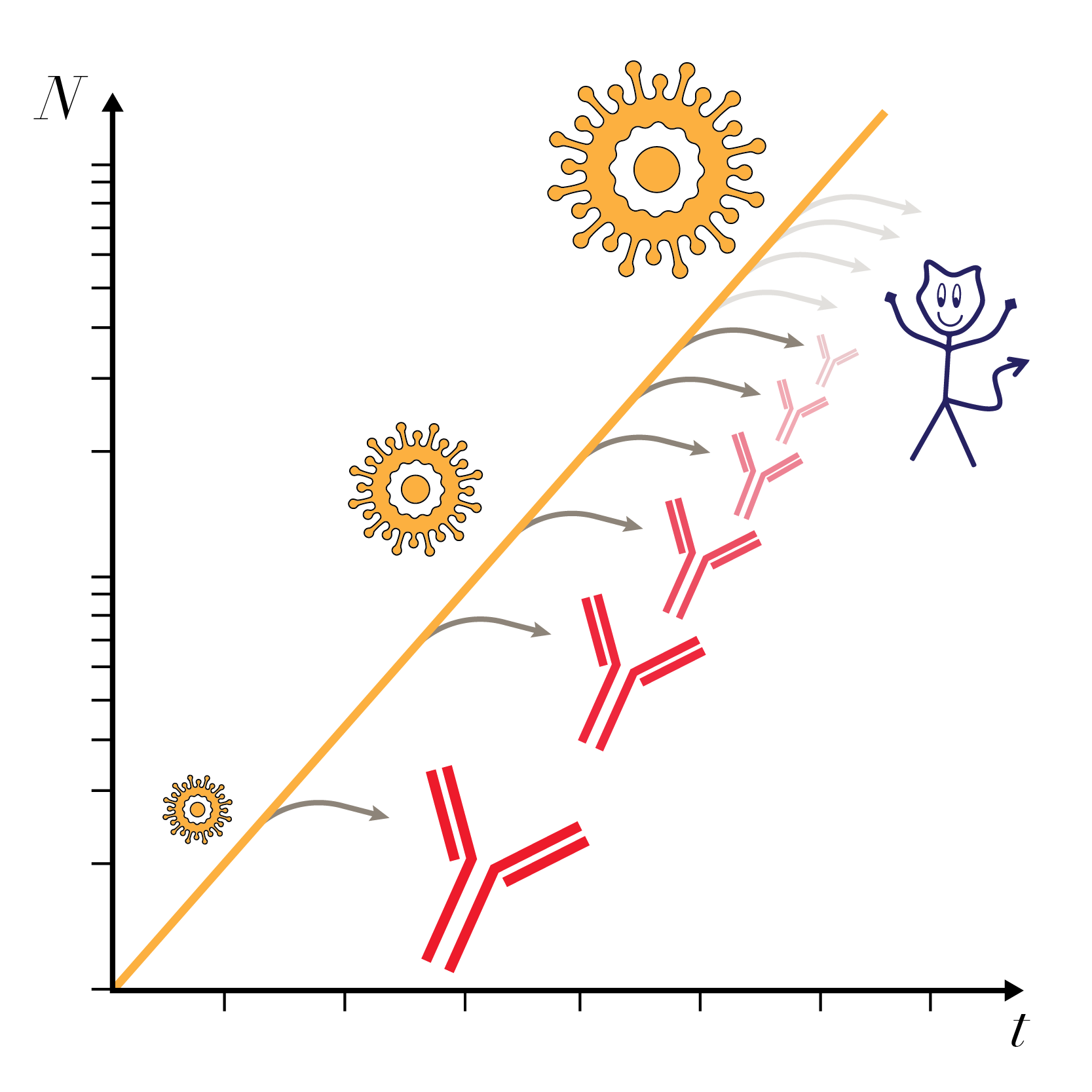
Summary: The immune response to an acute primary infection is a coupled process of antigen proliferation, molecular recognition by naive B cells, and their subsequent proliferation and antibody shedding. This process represents a fundamental open problem: the recognition of an exponentially time-dependent antigen signal by a diverse repertoire of receptors. In this work, we show that B cells can efficiently recognize new antigens by a tuned kinetic proofreading mechanism in which the molecular recognition machinery is adapted to the complexity of the immune repertoire. This process produces potent, specific, and rapid recognition of antigens while maintaining a spectrum of genetically distinct B cell lineages as input for affinity maturation in germinal centers. We show that the proliferation-recognition dynamics of a primary infection is a generalized Luria-Delbrück process, akin to the dynamics of the classical fluctuation experiment. This map establishes a link between signal recognition dynamics and evolution. We extend the model to include spatio-temporal processes, including the diffusion-recognition dynamics of a vaccination. By incorporating parameters from different levels of complexity, from the molecular to the organismal, into a single dynamical framework, our model allows the study of the immune system across scales. We derive the resulting statistics of the activated immune repertoire: antigen binding affinity and expected clone size of active B cell clones are related by power laws that define the class of generalized Luria-Delbrück processes. Their exponents, which are experimentally accessible, depend on the antigen and B cell proliferation rate, the number of proofreading steps, and the lineage density of the high-affinity naive repertoire. Preliminary data from activated mouse immune repertoires are found to be consistent with activation involving about three proofreading steps. Thus, this unified approach establishes infection and vaccination as a new way to study the global architecture and functional principles of immune repertoires. Finally, the model predicts key clinical characteristics of acute infections and vaccination. As a hallmark of Luria-Delbrück processes, it predicts large heterogeneity in the final clonal composition of the activated B cell population. This results in large fluctuations in the final potency of the response. Moreover, given the predicted correlation between clone size and binding affinity in activated lineages, jackpot clones often emerge as elite neutralizers: large high-affinity B cell clones. In addition, the model elucidates the effects of aging on the quality of a primary immune response. By reducing the size of the naive repertoire and thus the number of high-affinity B cell lineages, aging leads to delayed and weaker immune responses.